Having a buddy

One of my favorite things at the WPC in Barcelona was the Buddies Program. At our request, we can be matched, “buddied up,” with other people from around the world. The idea is to create space for global dialogue, discussion and companionship across all borders.

I applied to the program and after I was notified of my match, we started exchanging emails and photos. My new amiga, Paqui Ruiz, is from Tenerife in the Canary Islands. She is a dynamic woman! She is the president, co-founder and co-facilitator of a collaboration of young women with Parkinson’s disease across the globe who speak Spanish. Her work has expanded to include radio shows, personal testimonies, advocacy, and more.
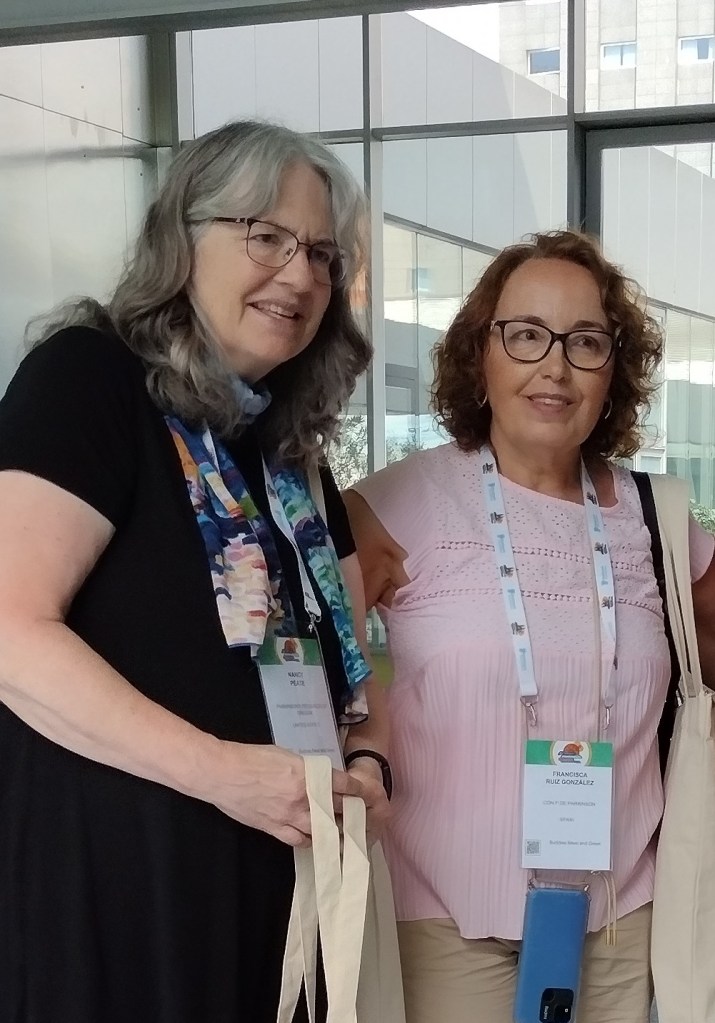
Nancy (left) and Paqui (right)

Although I speak only a little Spanish, it didn’t matter. We occasionally asked our mutual friend, Claudia, and also my husband, to help us by translating for the two of us. Despite not having a common language, Paqui and I easily communicated with smiles and warm hugs. No matter how serious or complex the topics we were exploring in the conference sessions, my day automatically brightened whenever I saw my buddy.

Paqui is involved in research projects for young women with Parkinson’s, and her work stands to positively contribute to the advancement of treatment. After the conference was over, we bid goodbye, but I’m confident that we will keep in touch. We have a special bond created by the Buddies Program, and I hope we will meet again.

When Parkinson’s Makes You Feel Small

When Parkinson’s makes you feel small, go big. Stand up tall.

When people don’t seem to hear you, and they say you mumble, enunciate. Make yourself heard.

When you are feeling defeated, go out and conquer.

When you are scared, be brave. Have courage.

When you feel all alone, remember there are people in this world — your spouse, your kids, your friends, your family, even strangers — who love you.

Credit to Coach Kimberly and the Rebel Fit Boxing Club

Fog over Tilikum Crossing

The first rule of fight club

“The first rule of Fight Club is you do not talk about Fight Club.”

Image may contain: one or more people
Ken helps Harry put on gloves

Clearly Chuck Palahniuk wasn’t talking about Parkinson’s Boxing. The first rule of Parkinson’s Boxing is you tell any one that it might help. Because Parkinson’s Boxing takes people challenged by a chronic illness and builds them into a fighter.

Exercise is literally the only tool we have to slow the progression of the disease. We’re fighting for our lives.

Recently three of us, Kat, Harry and I, were invited to work out at a Rock Steady class in Kauai. There we met some remarkable fighters. The class was similar to the one that Kat and I attend in Portland, Kimberly Berg’s Rebel Fit Club, which is dedicated to people with Parkinson’s and other movement disorders.

Our workout was similar: weights, speed bag, ropes. The view looking out at Kauai’s luscious green hills was magnificent. We were even invited to spar.


Image may contain: 1 person, shoes
Sparring with Coach Ron …
Image may contain: 1 person, shoes
and contact!

Here’s the whole group of fighters at the end. It was a pretty sweaty group.

Image may contain: 12 people, including Kat Hill and Lisa Harris- Murphey, people smiling

That’s Kat, bending down behind Harry, Coach Ron next to Harry, and me in the blue. Behind my right shoulder is our new friend and boxing hero Lisa who we hope to see in Oregon this summer. Actually we’d be happy to see any of these kind people come visit us.


Image may contain: one or more people and people sitting

We’re brave. We’re mighty.

Why I put on gloves

Ooooh, I forget how cold and unforgiving boxing gloves can be. Someone — maybe Kimberly, our coach — or one of her many volunteers — will help us tighten the straps around each wrist.

This image has an empty alt attribute; its file name is fb_img_1567778175123.jpg
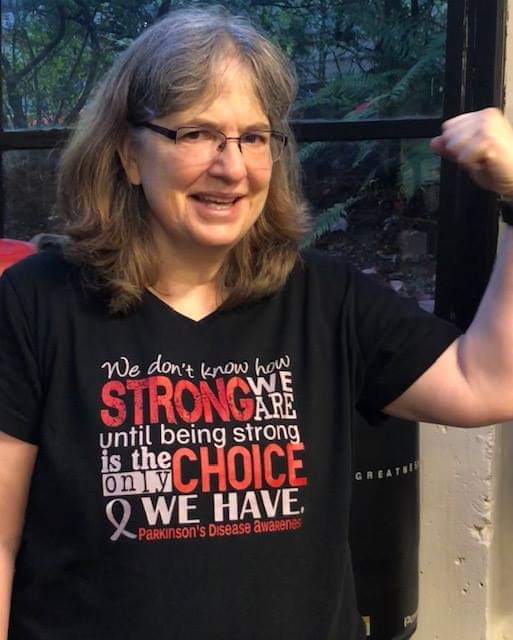
We don’t know how strong we are until being strong is the only choice we have (image on shirt).

But first, there’s some ferocious hugging and greeting to be done. You’d assume that the Rose City Knock-Out Ladies — all of us with our own unique diagnosis of Parkinson’s Disease — hadn’t seen each other for more than a day or two.

We laugh and sometimes cry and then we admire each other’s earrings and see if someone has new workout gear. There’s news to share, not always good. Then it’s time to head to the punching bags with the others.

Away from the boxing gym, I suffer small losses all day long. My foot drags. I forget a word, my fingers clench and keep me from typing any faster than a key at a time. I remind myself to stand up, don’t give in to stooping, swing my right arm when I walk. Every day, I fight to do the easiest things: shower, get dressed — don’t get me started on sports bras! — hurry for the bus, and try to balance gracefully if I don’t get a seat. Every day I work at not falling into the laps of strangers.

But in the boxing gym, I’m strong. With gloves on, I hit the bags with everything I have. Call it fighting, call it stress relief, call it major annoyance at this cold and unforgiving disease.

Afterwards, I sometimes need help getting my gloves off. They’re warm and damp inside. I’m dripping with sweat, my face a lovely red. And my heart pounds. I am strong and alive.