Having a buddy

One of my favorite things at the WPC in Barcelona was the Buddies Program. At our request, we can be matched, “buddied up,” with other people from around the world. The idea is to create space for global dialogue, discussion and companionship across all borders.

I applied to the program and after I was notified of my match, we started exchanging emails and photos. My new amiga, Paqui Ruiz, is from Tenerife in the Canary Islands. She is a dynamic woman! She is the president, co-founder and co-facilitator of a collaboration of young women with Parkinson’s disease across the globe who speak Spanish. Her work has expanded to include radio shows, personal testimonies, advocacy, and more.
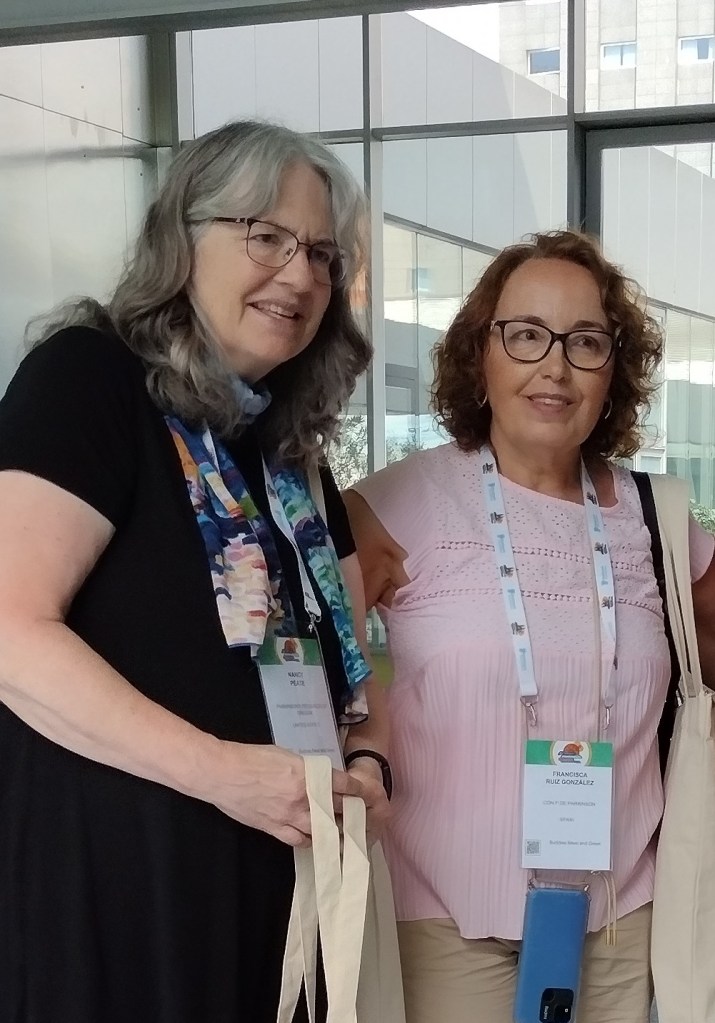
Nancy (left) and Paqui (right)

Although I speak only a little Spanish, it didn’t matter. We occasionally asked our mutual friend, Claudia, and also my husband, to help us by translating for the two of us. Despite not having a common language, Paqui and I easily communicated with smiles and warm hugs. No matter how serious or complex the topics we were exploring in the conference sessions, my day automatically brightened whenever I saw my buddy.

Paqui is involved in research projects for young women with Parkinson’s, and her work stands to positively contribute to the advancement of treatment. After the conference was over, we bid goodbye, but I’m confident that we will keep in touch. We have a special bond created by the Buddies Program, and I hope we will meet again.
Interview with “When Life Gives You Parkinson’s”

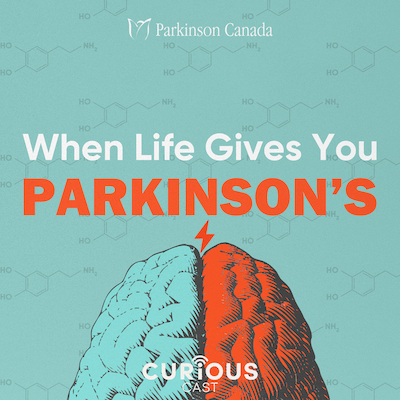
It was a real pleasure to be interviewed recently for Larry Gifford’s podcast, “When Life Gives You Parkinson’s.” Larry has a fabulous radio voice and presence, and he brings interesting topics to the table. His partner, Rebecca, helps to guide the conversation with her insights and artful questions.

Larry talked with my co-author Kat Hill and me about our new book, Being Well with Chronic Illness, A Guide to Joy & Resilience with Your Diagnosis, which was just published by Hatherleigh Press. Our book is distributed by Penguin Random House. The heart of our book is the Wellness Spiral, which is a model that we developed to support being well after an unexpected diagnosis.

You can get “When Life Gives You Parkinson’s” anywhere you get your podcasts. If you feel it deserves it, like I do, be sure to subscribe and share.

https://curiouscast.ca/podcast/160/when-life-gives-you-parkinsons/

When Parkinson’s Makes You Feel Small

When Parkinson’s makes you feel small, go big. Stand up tall.

When people don’t seem to hear you, and they say you mumble, enunciate. Make yourself heard.

When you are feeling defeated, go out and conquer.

When you are scared, be brave. Have courage.

When you feel all alone, remember there are people in this world — your spouse, your kids, your friends, your family, even strangers — who love you.

Credit to Coach Kimberly and the Rebel Fit Boxing Club

Fog over Tilikum Crossing

Targeting the Brain

We may not be talking about rocket science, but deep brain simulation (DBS) is definitely brain surgery and it’s incredibly invasive. It’s the last hope of many people with Parkinson’s disease. It’s both a scary proposition and a beacon of hope.

Renewed hope

That’s why it’s good news that two recent studies in the journal Nature Medicine show that electrical simulation can address brain function with surprising speed and precision. Scientists are now looking at DBS techniques for purposes other than Parkinson’s disease, including depression and anxiety. The more light that is shining on DBS, the better the outcome.

As reported in the February 28, 2021 edition of the New York Times Magazine, a team from the University of California, San Francisco, mapped a patient’s brain activity and programmed electrodes to detect when the patient was depressed. This works similar to how a pacemaker acts on the heart. When the patient is fine, the electrodes do nothing; when she’s depressed, they deliver stimulation in response.

In the second study out of Boston University, researchers used a noninvasive technique called transcranial alternating current stimulation to deliver pulses. Their goal was to reduce obsessive-compulsive behaviors. By using personalized brain stimulation, they reduced the number of these behaviors by 30% over three months.

Psychiatrists won’t be prescribing DBS any time soon, but this research offers news ways to think about treating brain disorders. It’s more evidence that “our brains are plastic,” according to one of the Boston researchers, “and we can rewire the brain.” Maybe in the not-so-very-distant-future, these less-invasive transcranial techniques will assist targeted brain treatments to stop Parkinson’s disease from advancing. Take that, rocket science.

Holding steady

It’s been eight weeks since the earth flipped around.

I’m still here, trying to hold steady. For me, it’s a time when nothing feels easy. I search for rhythm in my days. I create lists that peter out after two or three items. I try to finish something, anything.

Each night, I decide to make it a bright day tomorrow.

I remember the things that have saved me before. Writing in my journal. Meditating. Exercise. Friends. Breathing.

Yesterday, the sun came out. The neighbors gathered for a Sunday afternoon socially distant check-in in our yard.

I poured a small glass of wine and went out the front door.

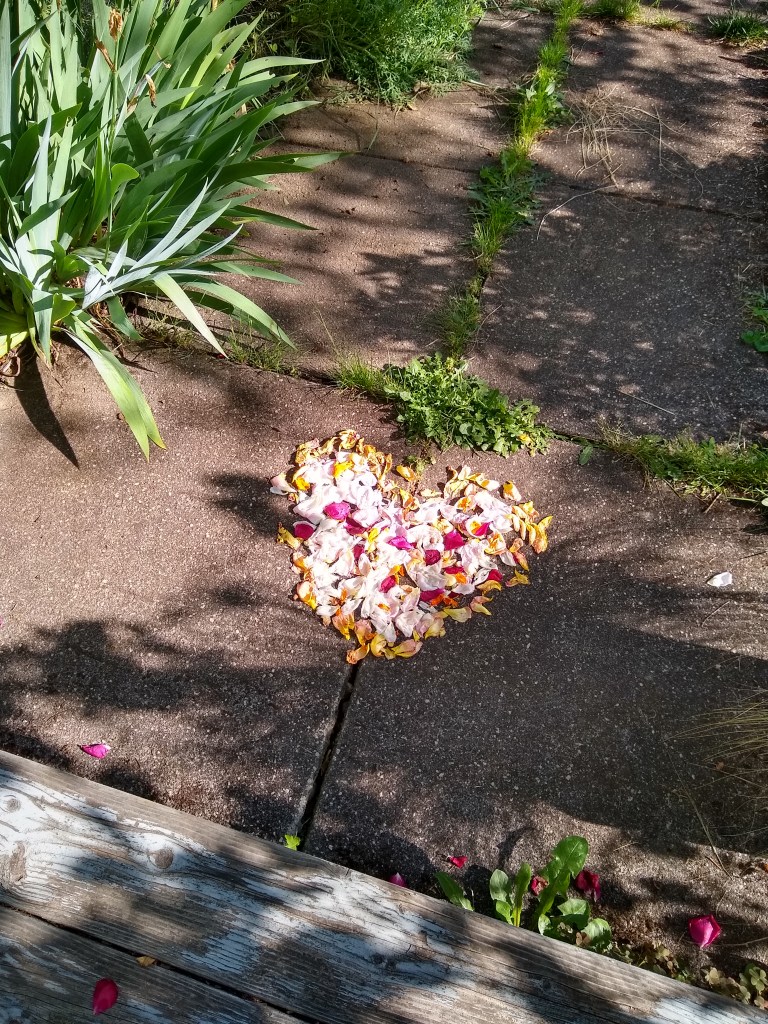
There it was: a heart made of rose petals. A bit of whimsy created as a token of affection by a neighbor.

A gift from the earth. Gratitude, affection, hope.

I’m still here, holding steady.

Who’s zoomin’ who?

Life in the time of SARS-CoV-2

Tai chi. Yoga. Boxing. Book club. Work, of course. Even my friends that get together for coffee every Monday and Friday morning. We all meet on Zoom now.

Zoom wasn’t even active in my lexicon eight weeks ago. At first it seemed like amazing technology, because after the first week of quarantine, I was desperate to see a real person.

I really miss seeing real people!

I don’t like how the camera is always on. I don’t need to see my reflection. I’m tired of living in Screen Land.

The news says it might be safe soon to relax some of the social distancing rules that keep us from being with each other. I don’t believe it’s safe yet. But it sure would be nice.

Hiring weather

I caught my first glimpse of Oregon years ago on a February spring day. I was interviewing for my first job out of college and I heard the weather called “hiring weather.” This meant that fresh-eyed college kids like me would be easy to impress.

Was I! I was stunned by the sunny weather. And the blue skies. I could see snow-capped Mt. Hood and Mt. St. Helens on the horizon. I’d been warned that Oregon was mostly grey skies and rain, and that it would be a depressing, dreary place to live. Nobody had told me about this.

It was snowing when I left Colorado earlier that week. I was eager to take my next steps after school, very aware it meant moving away from home and taking on the work I had studied long to do. Even more than the sun, I was amazed by all the bulbs that were in bloom. Bright daffodils. Tulips. White and purple crocuses.

This morning, many years after I caught that first glimpse of Oregon, our yard is vibrant in yellow and purple with its annual show of February bulbs.

I believe this day is medicine, every bit as much as the Sinemet and Ropinerole that I take. I sit on the front steps and feel the sun on my face. As in-depth as science has studied dopamine, the only clear link I can find between dopamine and the sun is a theory that sunlight increases the number of dopamine receptors. This creates vitamin D which activates the genes that release dopamine. That’s good enough for me.

I think of the words of Thich Nhat Hanh: “You are a child of the sun, you come from the sun… and the earth is in you.”

Tomorrow is soon enough for the skies to be grey and rainy. Today I will read and sketch and make music and drink tea. Today is “hiring weather” and I want to hire whatever there is to hire. That includes several bright yellow bunches of daffodils out today, showcasing our yard.

A still, small voice

In her memoir, “Are You Somebody?” author Nuala O’Faolain describes her common experience of being recognized in public but not being easily identified or named. People guessed that she was famous but they couldn’t say who she was. She would be in a lounge bar or the grocery store, and be asked “Are you somebody?”

Aren’t we all somebody? Even as we grow comfortable with our skin and the landscape around us, we can find it hard to listen to our own inner voice. As we get older, the possibilities of being “somebody” narrow down into a more slender path. We realize, for example, there will be no athletic career for us, nor are we likely to go into politics. Or acting or a host of other things.

Still, that’s not the kind of “Are you somebody” question that we’re asking. We’re all out here in our own little vessels, these aging bodies, these failing brains. It’s all we’ll ever have. As O’Faolain wrote, we’re not anybody in terms of the world, but then, “who decides what a somebody is? How is a somebody made?” O’Faolain believed she’d never done anything remarkable; neither have most people. Yet, most people, feel remarkable.

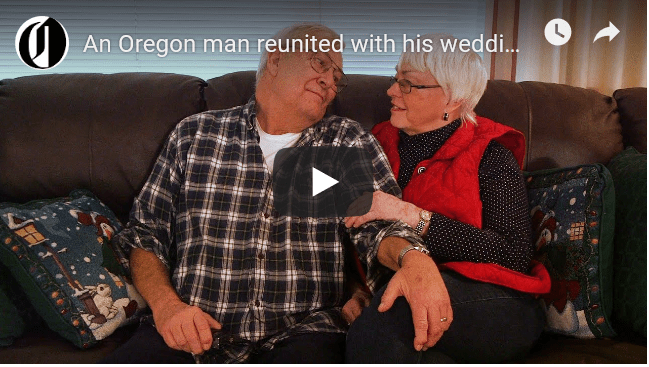
Recently I was slightly remarkable, or, rather I was mentioned in the newspaper. In the course of my work as a research librarian, I helped an elderly couple reunite with a lost wedding band. (You can read about it in the article below.)

Oregon man reunited with his wedding ring

The article was picked up by a couple of other news agencies and it was also reprinted later in the week. By that time, my name had been edited out of the story. I was remarkable and then I wasn’t.

There is a yoga practice where you say your given name out loud three times, and wait in a meditative pose. And sometimes people hear their own desires, their own small voice responds. It reassures us that we all are somebody, we all matter. The psychoanalyst Carl Jung warns us, though, that it is easy to deceive ourselves. I think that when we are able to be sufficiently quiet and our thoughts are open, there is no deceit. That’s when our still, small voice — the “somebody” that we are — can speak.

Keeping up with research

Let’s say you hear about a new drug or a research trial. Or you attend a conference. After hearing a particularly inspiring speaker, you may want to make some changes to your routines or diet or whatever, or do some of your own investigating. How do you get started? It can be overwhelming, but there are many tools available to help you become better informed.

Image result for carry a small notebook

Carry a small notebook

One good habit is to make notes about any topics that catch your interest. Write as soon as you can, while the information is still fresh. Describe who told you or where you first heard about it. You can make a note online, or send yourself a text.

Keep an eye on media

Most online and broadcast stations keep an index of previous subjects. If there was a newly-published book being publicized, you can check a website such as FreshFiction.com. They review the top “buzzed” books of the week on shows like Good Morning America, Today Show, NPR and Public Radio programs, and many more.

If it was a magazine article, use your cellphone to take a photo of the article and also snap the cover of the magazine that shows the date or edition. If it isn’t a magazine that you have at hand, check with your library to see if they can get a copy of the article for you.

Capture what you know, however little

Did you overhear people talking, say at the gym, but didn’t quite catch the details? Try to capture what you do know, or what it sounded like, to the best of your ability. The important thing is to get down enough information so that you can follow up.

Evaluate research results

You’ll need to read carefully the research that interests you. Studies can be flawed, or worse, make claims that their own research doesn’t support. I like to ask if something passes the “Reasonable Test” — does it seem reasonable?

Be wary of any articles that make outrageous claims. You’ll want to read and think carefully about what’s being presented. Is the source legitimate? Would you trust them under different circumstances? If it’s a new medicine, has it gone through rigorous testing? Was the research done on a large enough group of people? Keep track of the skeptical questions you have. It’s easy to fall for a false promise when one is eager for a cure.