Having a buddy

One of my favorite things at the WPC in Barcelona was the Buddies Program. At our request, we can be matched, “buddied up,” with other people from around the world. The idea is to create space for global dialogue, discussion and companionship across all borders.

I applied to the program and after I was notified of my match, we started exchanging emails and photos. My new amiga, Paqui Ruiz, is from Tenerife in the Canary Islands. She is a dynamic woman! She is the president, co-founder and co-facilitator of a collaboration of young women with Parkinson’s disease across the globe who speak Spanish. Her work has expanded to include radio shows, personal testimonies, advocacy, and more.
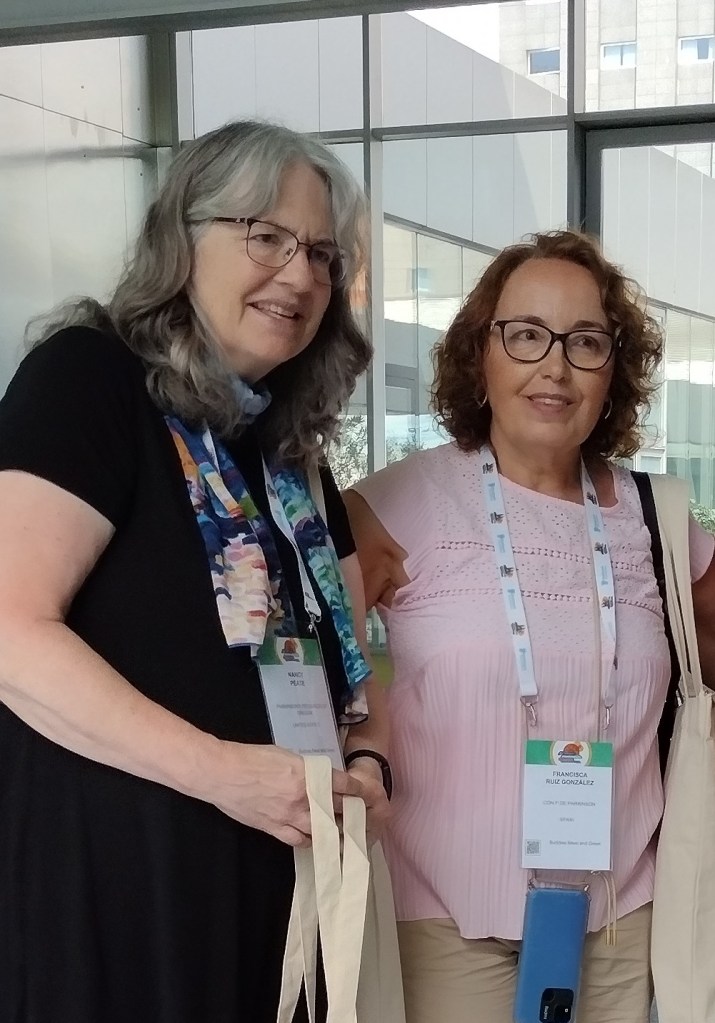
Nancy (left) and Paqui (right)

Although I speak only a little Spanish, it didn’t matter. We occasionally asked our mutual friend, Claudia, and also my husband, to help us by translating for the two of us. Despite not having a common language, Paqui and I easily communicated with smiles and warm hugs. No matter how serious or complex the topics we were exploring in the conference sessions, my day automatically brightened whenever I saw my buddy.

Paqui is involved in research projects for young women with Parkinson’s, and her work stands to positively contribute to the advancement of treatment. After the conference was over, we bid goodbye, but I’m confident that we will keep in touch. We have a special bond created by the Buddies Program, and I hope we will meet again.
Interview with “When Life Gives You Parkinson’s”

It was a real pleasure to be interviewed recently for Larry Gifford’s podcast, “When Life Gives You Parkinson’s.” Larry has a fabulous radio voice and presence, and he brings interesting topics to the table. His partner, Rebecca, helps to guide the conversation with her insights and artful questions.

Larry talked with my co-author Kat Hill and me about our new book, Being Well with Chronic Illness, A Guide to Joy & Resilience with Your Diagnosis, which was just published by Hatherleigh Press. Our book is distributed by Penguin Random House. The heart of our book is the Wellness Spiral, which is a model that we developed to support being well after an unexpected diagnosis.

You can get “When Life Gives You Parkinson’s” anywhere you get your podcasts. If you feel it deserves it, like I do, be sure to subscribe and share.

https://curiouscast.ca/podcast/160/when-life-gives-you-parkinsons/

When Parkinson’s Makes You Feel Small

When Parkinson’s makes you feel small, go big. Stand up tall.

When people don’t seem to hear you, and they say you mumble, enunciate. Make yourself heard.

When you are feeling defeated, go out and conquer.

When you are scared, be brave. Have courage.

When you feel all alone, remember there are people in this world — your spouse, your kids, your friends, your family, even strangers — who love you.

Credit to Coach Kimberly and the Rebel Fit Boxing Club

Fog over Tilikum Crossing

Targeting the Brain

We may not be talking about rocket science, but deep brain simulation (DBS) is definitely brain surgery and it’s incredibly invasive. It’s the last hope of many people with Parkinson’s disease. It’s both a scary proposition and a beacon of hope.

Renewed hope

That’s why it’s good news that two recent studies in the journal Nature Medicine show that electrical simulation can address brain function with surprising speed and precision. Scientists are now looking at DBS techniques for purposes other than Parkinson’s disease, including depression and anxiety. The more light that is shining on DBS, the better the outcome.

As reported in the February 28, 2021 edition of the New York Times Magazine, a team from the University of California, San Francisco, mapped a patient’s brain activity and programmed electrodes to detect when the patient was depressed. This works similar to how a pacemaker acts on the heart. When the patient is fine, the electrodes do nothing; when she’s depressed, they deliver stimulation in response.

In the second study out of Boston University, researchers used a noninvasive technique called transcranial alternating current stimulation to deliver pulses. Their goal was to reduce obsessive-compulsive behaviors. By using personalized brain stimulation, they reduced the number of these behaviors by 30% over three months.

Psychiatrists won’t be prescribing DBS any time soon, but this research offers news ways to think about treating brain disorders. It’s more evidence that “our brains are plastic,” according to one of the Boston researchers, “and we can rewire the brain.” Maybe in the not-so-very-distant-future, these less-invasive transcranial techniques will assist targeted brain treatments to stop Parkinson’s disease from advancing. Take that, rocket science.

Stand as you are able

These are hard times. We all have reasons to hold ourselves back. Still, every morning we wake up to one more day, until the day we don’t. We have every freaking day. So we try to make some small part of our world a little better. We educate ourselves about nuanced issues. We talk, and our conversations sometimes lead to our heart and our best intentions. We become advocates for our self and for others. We stand as we are able.

An advocate publicly supports or suggests a new way forward.

Take a look at the house of my dear friends who live down the street. Their place is a freakingly humble example of advocacy. There’s a no-charge pay phone and a hand-washing station, and it’s not unusual to walk by any hour of the day and see someone using one or both. There are photos of Black men and one Black woman who died while in custody. There’s a rainbow peace flag.

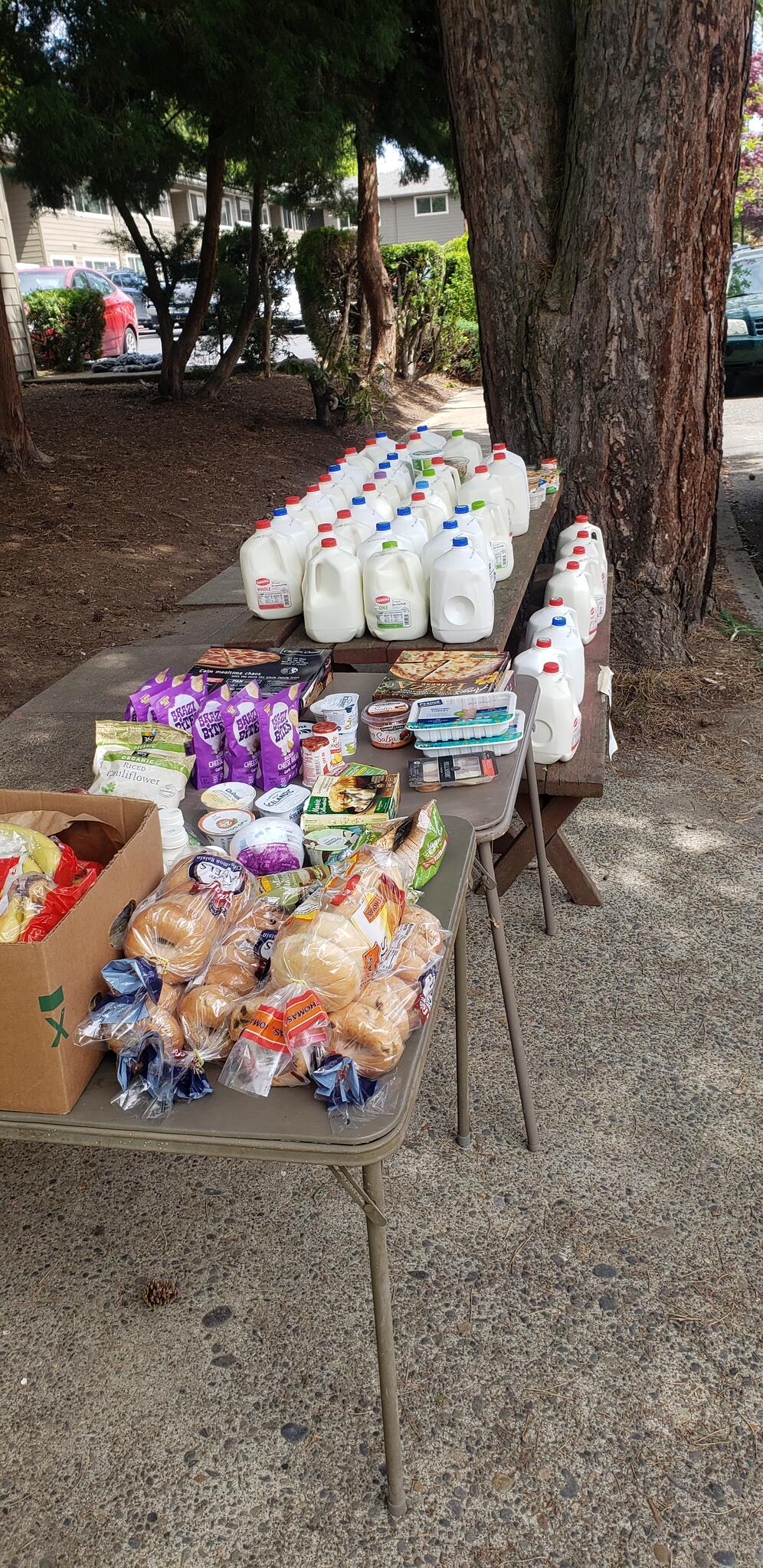
Now take a look at the free food table. This perishable food is donated by Trader Joe’s and Whole Foods via Central City Concern. It serves people in our neighborhood who have lost their jobs and are running out of things.

People are encouraged to stop by the table or pass the information on to anyone who might need it.

Some days there’s fresh milk and bagels. Or potatoes. Heads of broccoli, snap peas.

Once I snagged a Snickerdoodle.

At the end of the day, if there’s a lot of perishable food left, there might be a barbecue and dinner is served.

If you want to know more about the people who live here, ask me. I feel protective of their privacy and, also, this is their hard work, not mine.

All this leads to a simple question. What can we — what can I — do to be a better advocate for our selves, our world and the things we believe in, despite what holds us back? Stand as you are able. It’s a new freaking day.

Holding steady

It’s been eight weeks since the earth flipped around.

I’m still here, trying to hold steady. For me, it’s a time when nothing feels easy. I search for rhythm in my days. I create lists that peter out after two or three items. I try to finish something, anything.

Each night, I decide to make it a bright day tomorrow.

I remember the things that have saved me before. Writing in my journal. Meditating. Exercise. Friends. Breathing.

Yesterday, the sun came out. The neighbors gathered for a Sunday afternoon socially distant check-in in our yard.

I poured a small glass of wine and went out the front door.

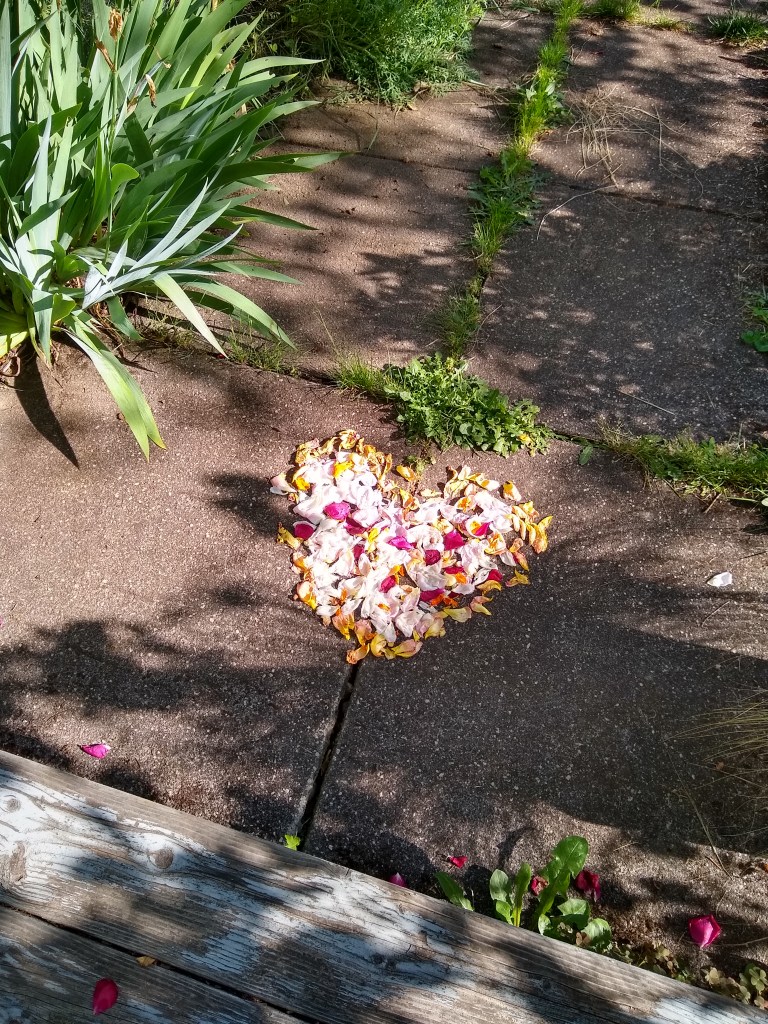
There it was: a heart made of rose petals. A bit of whimsy created as a token of affection by a neighbor.

A gift from the earth. Gratitude, affection, hope.

I’m still here, holding steady.

Who’s zoomin’ who?

Life in the time of SARS-CoV-2

Tai chi. Yoga. Boxing. Book club. Work, of course. Even my friends that get together for coffee every Monday and Friday morning. We all meet on Zoom now.

Zoom wasn’t even active in my lexicon eight weeks ago. At first it seemed like amazing technology, because after the first week of quarantine, I was desperate to see a real person.

I really miss seeing real people!

I don’t like how the camera is always on. I don’t need to see my reflection. I’m tired of living in Screen Land.

The news says it might be safe soon to relax some of the social distancing rules that keep us from being with each other. I don’t believe it’s safe yet. But it sure would be nice.

The first rule of fight club

“The first rule of Fight Club is you do not talk about Fight Club.”

Image may contain: one or more people
Ken helps Harry put on gloves

Clearly Chuck Palahniuk wasn’t talking about Parkinson’s Boxing. The first rule of Parkinson’s Boxing is you tell any one that it might help. Because Parkinson’s Boxing takes people challenged by a chronic illness and builds them into a fighter.

Exercise is literally the only tool we have to slow the progression of the disease. We’re fighting for our lives.

Recently three of us, Kat, Harry and I, were invited to work out at a Rock Steady class in Kauai. There we met some remarkable fighters. The class was similar to the one that Kat and I attend in Portland, Kimberly Berg’s Rebel Fit Club, which is dedicated to people with Parkinson’s and other movement disorders.

Our workout was similar: weights, speed bag, ropes. The view looking out at Kauai’s luscious green hills was magnificent. We were even invited to spar.


Image may contain: 1 person, shoes
Sparring with Coach Ron …
Image may contain: 1 person, shoes
and contact!

Here’s the whole group of fighters at the end. It was a pretty sweaty group.

Image may contain: 12 people, including Kat Hill and Lisa Harris- Murphey, people smiling

That’s Kat, bending down behind Harry, Coach Ron next to Harry, and me in the blue. Behind my right shoulder is our new friend and boxing hero Lisa who we hope to see in Oregon this summer. Actually we’d be happy to see any of these kind people come visit us.


Image may contain: one or more people and people sitting

We’re brave. We’re mighty.